

The newly launched Internationalisation Award showcases examples of good practice in implementing the goals of the National Mobility and Internationalisation Strategy for Higher Education 2020-2030 (HMIS2030) in Austria. The Internationalisation Award is presented in four categories and aims to highlight examples of good practice for internationalisation of the curriculum, the promotion of mobility of university staff and underrepresented student groups, and internationalised university culture in practice. All submissions for the Internationalisation Award have been published on hmis2030.at and create a growing repository of good practices.
A Holistic Approach to Internationalisation
HMIS2030 is based on a holistic understanding of internationalisation of higher education beyond student mobility. Building on principles first laid out by Betty Leask, the strategy aims to integrate global, international and intercultural dimensions into the entire teaching and learning environment. Internationalisation in this sense affects all levels of higher education institutions and all their members, from students to teachers and administrative staff. The Internationalisation Award reflects this broad vision by recognizing diverse practices that bring internationalisation to life.
Internationalisation Award: Four categories towards one goal
The Internationalisation Award was jointly created by Austria’s Agency for Education and Internationalisation (OeAD) and the Austrian Federal Ministry of Women, Science and Research (BMFWF). The Award’s four categories are based on the strategic goals of HMIS2030, measures to be awarded differ in terms of their respective target groups. Taken together, the four categories include all university members and set the framework for identifying creative and innovative implementation of the strategy at higher education institutions across different sectors.
- Category 1: Internationalisation of the Curriculum – Internationalisation of learning and teaching
- Category 2: Mobility and skills development for teaching and administrative university staff
- Category 3: Mobility for under-represented student groups
- Category 4: Internationalised university culture in practice
By acknowledging and rewarding examples of good practice, the Internationalisation Award serves as a policy instrument by pushing the strategy itself – while at the same time increasing the visibility of examples of good practice in implementing the strategy and promoting peer learning.
First Edition 2025: From vision to action
The first edition of the Internationalisation Award was announced in spring 2025. Submissions were accepted from mid-April until mid-July 2025. The response was strong: In total, 103 submissions were received from 38 distinct higher-education institutions across Austria, representing all four types of Austrian HEIs. The high participation underlines the motivation among institutions to share their commitment to strategic internationalisation and practices that others might adapt.
Over the summer, the Internationalisation Award Jury, consisting of three experts on internationalisation from HEIs in Switzerland and Germany and a student representative also from Germany evaluated all submissions and chose the winners in the jury meeting at the beginning of October. The award ceremony then took place on 27 November and winners received their Internationalisation Award trophies and certificates from Austrian federal minister Eva-Maria Holzleitner.
Examples of Award-Winning Practices
This year’s Internationalisation Award winners illustrate the diversity of internationalisation practices:
In the category “Internationalisation of the Curriculum”, the winner was FH JOANNEUM (University of Applied Sciences) for their project Enabling Mobility in Dietetics. FH JOANNEUM showcased how study programmes in dietetics incorporated structured mobility and curricular internationalisation rather than treating mobility as an add-on.
The first place in the category “Mobility and skills development for teaching and administrative university staff” was awarded to the University of Innsbruck. Their Internationalisation Certificate for Administrative Staff aims to build international and intercultural competences among administrative university staff.
In the third category “Mobility for under-represented groups”, top honours went to the Academy of Fine Arts Vienna. Their example of good practice demonstrates that mobility programmes can and should be made accessible to a diverse student body.
Last but not least, the Technical University Graz was awarded the first place in the category “Internationalised university culture in practice”. The International House of TU Graz is an initiative fostering an inclusive and international institutional culture.
These examples – together with all other submissions – showcase how internationalisation may take many forms: curricular reform, staff training, inclusive mobility, campus culture and many more.
HMIS2030.at: A Growing Repository of Good Practice
All submissions for the Internationalisation Award have been published on hmis2030.at and create a growing repository of good practices. The submissions are also available in English and serve as inspirations for institutions across Europe.
Following its success and positive feedback, the Internationalisation Award will be back with a second edition in 2026 to once again reward the real-world implementation of HMIS2030. The Internationalisation Award will thus further strengthen the commitment of Austria’s higher education landscape to holistic internationalisation in line with the values of the European Higher Education Area.
For further information visit our website hmis2030.at or contact the Internationalisation Award team at hmis2030@oead.at.
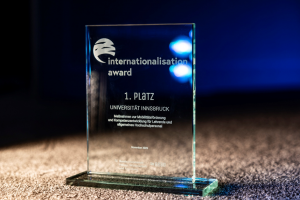
Picture description:
The picture shows the Internationalisation Award trophy.
Copyright: © OeAD/APA-Fotoservice/Hetfleisch